On June 4, 2026, Anthropic published “When AI builds itself,” proposing a globally coordinated pause or slowdown on frontier artificial intelligence (AI) development. The report argues that AI systems are accelerating their own development at a pace that may outstrip existing safety and governance frameworks. For organizations navigating AI procurement, deployment, and compliance, the proposal signals a potential shift in the regulatory and risk environment.
The Proposal and Its Conditions
Anthropic’s central recommendation is that the world should have the “option” to slow or temporarily pause frontier AI development “to enable societal structures and alignment research to keep up.” The company called a worldwide slowdown “likely a good thing” but stressed that if only one company stopped, competitors would race ahead.
Critically, Anthropic did not commit to a unilateral halt. A meaningful pause would require “multiple well-resourced labs at or near the frontier, in multiple countries, agreeing to stop under the same conditions,” with verifiable rules. Both the U.S. and China would need to participate simultaneously.
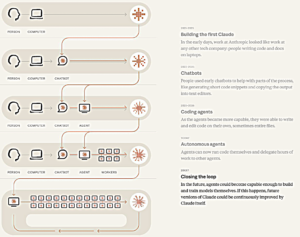
Key Data Points: The Acceleration of AI-Driven Development
The proposal is backed by internal data on AI capability acceleration. As of May 2026, more than 80 percent of code merged into Anthropic’s production codebase was authored by Claude, its AI assistant—up from low single digits before February 2025. Anthropic’s typical engineer now merges roughly eight times as much code per day as in 2024.
Anthropic acknowledged this metric overstates the true productivity gain; an internal poll placed the median self-reported uplift at approximately 4x.
External benchmarks corroborate the trajectory: the length of tasks AI models can reliably complete autonomously has been doubling roughly every four months. In internal tests, Anthropic's Mythos Preview model achieved approximately 52x performance improvements, far exceeding what skilled human engineers could accomplish.
The Core Risk: Recursive Self-Improvement
The concept driving Anthropic’s proposal is “recursive self-improvement”—the theoretical point at which an AI system becomes capable of autonomously designing its own successor with limited human involvement. Anthropic cautioned this “could come sooner than most institutions are prepared for," though it is "not inevitable."
Implications for Enterprise AI Governance
While Anthropic’s warning is framed around future AI development, analysts say it highlights governance questions that enterprises deploying autonomous AI agents are already confronting.
Ashish Banerjee, senior principal analyst at Gartner, said that “the issue is no longer just whether AI gives the right answer, but whether autonomous systems take the right action, at the right time, within the right authority.” Gartner predicts 40 percent of enterprises will demote or decommission autonomous AI agents by 2027 after governance failures.
Banerjee warned: “CIOs should stop treating AI agents as smarter chatbots—they are becoming digital workers with delegated authority and must be governed like privileged users, not productivity tools.”
Forrester’s Charlie Dai said governance can no longer depend primarily on human review: “Supervision becomes architectural, not manual.” Organizations will need bounded autonomy, embedded guardrails, and verifiable execution mechanisms designed into agentic systems from the outset.
Verification Challenges: Harder Than Nuclear Arms Control
Anthropic compared the coordination challenge to nuclear arms control but argued it would be even harder to enforce—AI training is easier to conceal than missile silos, and the incentive to quietly continue development would be enormous.
The Anthropic Institute said it will research verification mechanisms and plans to convene government officials, scientists, civil society organizations, and rival AI developers to explore how such a framework could work.
Regulatory and Political Landscape
The proposal arrives in a complex regulatory environment. Anthropic has faced pushback from industry competitors and White House officials who contend its worst-case focus overstates risks. David Sacks, an informal adviser to President Trump, has accused Anthropic of running a “regulatory capture agenda” that would ban lower-cost open-source models.
U.S. officials argue any slowdown risks handing China a decisive strategic edge. However, President Trump discussed AI safety cooperation with China during his recent Beijing visit and signed an executive order establishing a 30-day preliminary government review for the most powerful AI models before public release—a measure that stops short of a pause but introduces pre-release oversight.
Commercial Context and Skepticism
The report’s timing has drawn scrutiny. Anthropic confidentially filed for an initial public offering (IPO) around June 1, 2026, days before publishing the proposal. Its latest private funding round valued the company at approximately $965 billion, and the IPO could potentially exceed $1 trillion.
Critics have noted the tension between marketing AI-driven productivity to investors while arguing for a development slowdown. Holger Mueller of Constellation Research questioned: “Is it trying to freeze the status quo so it can catch up, or simply retain its lead?"
Industry-Wide Signals
Anthropic’s announcement does not exist in isolation. Google DeepMind CEO Demis Hassabis revised his AI timeline to “2029 is a real possibility.” OpenAI released GPT-5.3-Codex, claiming it “played a crucial role in creating itself.” The near-simultaneous signals from leading laboratories suggest broader industry recognition of accelerating AI advancement.
Key Takeaways for Legal and Compliance Teams
These developments suggest several areas of focus: (1) the acceleration of AI-driven software development raises urgent questions about accountability, code provenance, and audit trails; (2) the new 30-day federal pre-release review may impose new compliance obligations on organizations using or distributing frontier AI models; and (3) governance frameworks designed for generative AI may prove insufficient for autonomous agents, requiring oversight of runtime behavior, permissions, and decision boundaries.
Whether or not a coordinated global pause materializes, the regulatory environment for frontier AI is likely to become significantly more demanding. Organizations should evaluate whether their existing AI governance frameworks are designed for the speed and autonomy that current and next-generation systems are already demonstrating.
If you have any questions about Anthropic's call for a global AI pause, please contact Jade Davis or another member of Shumaker's Technology, Data Privacy, Cybersecurity & AI Service Line.