The Ohio Department of Medicaid (ODM) recently approved voluntary utilization management policies for certain community behavioral health services, effective July 1, 2026.
How the New Authorizations Work
Prior authorizations for the following services will be implemented as “pass through” authorizations, meaning that providers will not need to obtain authorization to initiate a service. However, prior authorization will be required once the applicable service threshold is met within a given calendar year.
The services subject to the new prior authorization requirements, along with their corresponding thresholds and Medicaid managed care plan turnaround times, are as follows:
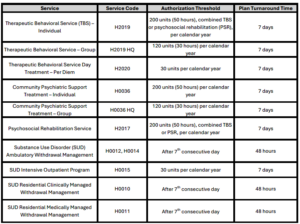
Further, Medicaid managed care plans must approve at least 90 days of behavioral health rehabilitation services before requiring prior authorization for additional services. This includes:
- Therapeutic Behavioral Service, individual (H2019) and unit-based group (H2019 HQ)
- Community Psychiatric Support Treatment, individual (H0036) and group (H0036 HQ)
- Psychosocial Rehabilitation Service (H2017)
Exclusions
The following services are excluded from the prior authorization requirements:
- Crisis Services as indicated by the KX modifier
- Behavioral Health Nursing services provided in accordance with OAC 5160-27-11
- Children and youth enrolled in OhioRISE
- Children and youth in the custody of Public Children Services Agencies
Implementation Timeline and Provider Expectations
While the Medicaid managed care plans are not required to adopt these new policies, the plans must notify their provider networks of any changes to their service authorization policies at least thirty (30) days before their effective date. Any services accrued before July 1, 2026, will not count towards the authorization thresholds.
Operationalizing these changes may be burdensome for some behavioral health providers and interfere with their service delivery. Please reach out to Daphne Kackloudis, Jordan Burdick, or Kate Crawford to discuss how the new utilization management policies may impact you and your practice.